
General Omar Bradley was the US General in command of US First Army and oversaw the D-Day invasion plans for Omaha and Utah beaches. He was born in Missouri in 1893 and served in North Africa and Sicily before his role with US First Army.
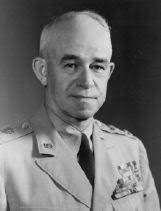
Bradley was appointed command of the “fledgling” 1st Army Group with its headquarters in London with First Army’s command to be based in Bristol. He “was to take First Army ashore as First Army commander and build it up on the beachhead. Once U.S. build-up had been expanded to a force the size of two armies, [Bradley] was to relinquish command of the First and step up to Group in command of them both).
Arrival in Bristol
His first description of Bristol is as “that onetime maritime center of the colonial slave trade” but it was a “convenient three hours by car from London [and] it stood strategically located at the gateway to southwest England where American troops were to be staged.”
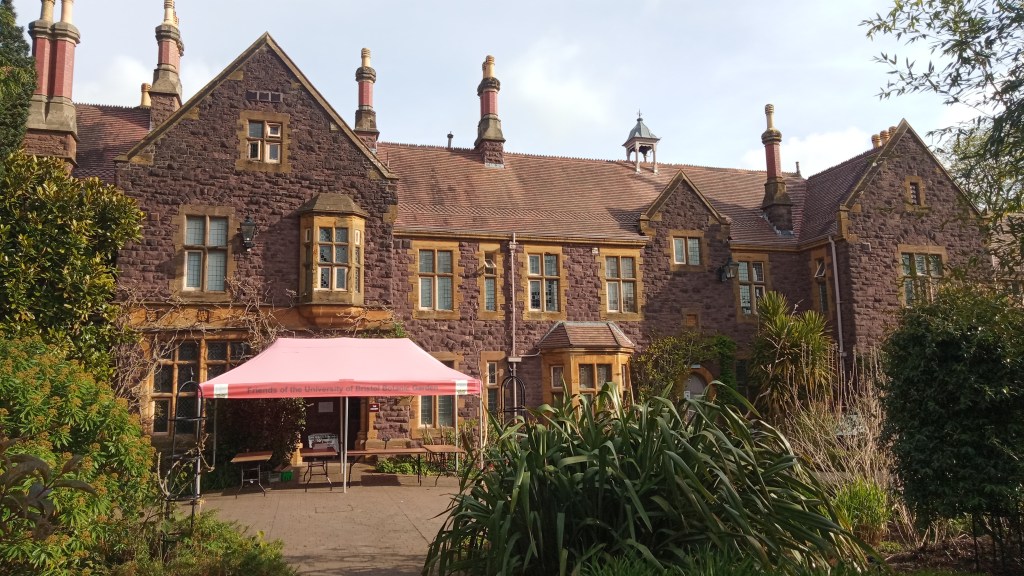
Bradley knew his time would be split between Bristol and London so he had arranged for billets in both, lodging in the Dorchester Hotel in the capital, which benefitted from a reinforced roof to protect it from bombing. In Bristol, The Holmes was requisitioned for him and his key staff officers which he described as “An English country home with ballroom, greenhouses, and stables, the house we were told, had been tentatively earmarked as a home for wayward girls. When the first American army truck rolled into its drive, the neighbors were said to have shrugged with resignation, if not relief.”
When Bradley arrived in Bristol, ‘The Holmes’ was not ready so he was to stay at the Grand Hotel, however, he wasn’t given quite the welcome he should have. The receptionist held up his hands and said “Sorry, gentlemen, but we honestly haven’t a vacant chamber. A good many travellers come to Bristol you know.” Only the intervention of Colonel Edward Gidley-Kitchen, commander of the Bristol Sub-Area changed the receptionist’s mind who looked up to Bradley and said “I hope, sir, that you won’t be staying long.” As Bradley quipped in his autobiography, neither did he as he “was in a hurry to cross the channel.”
A New Headquarters
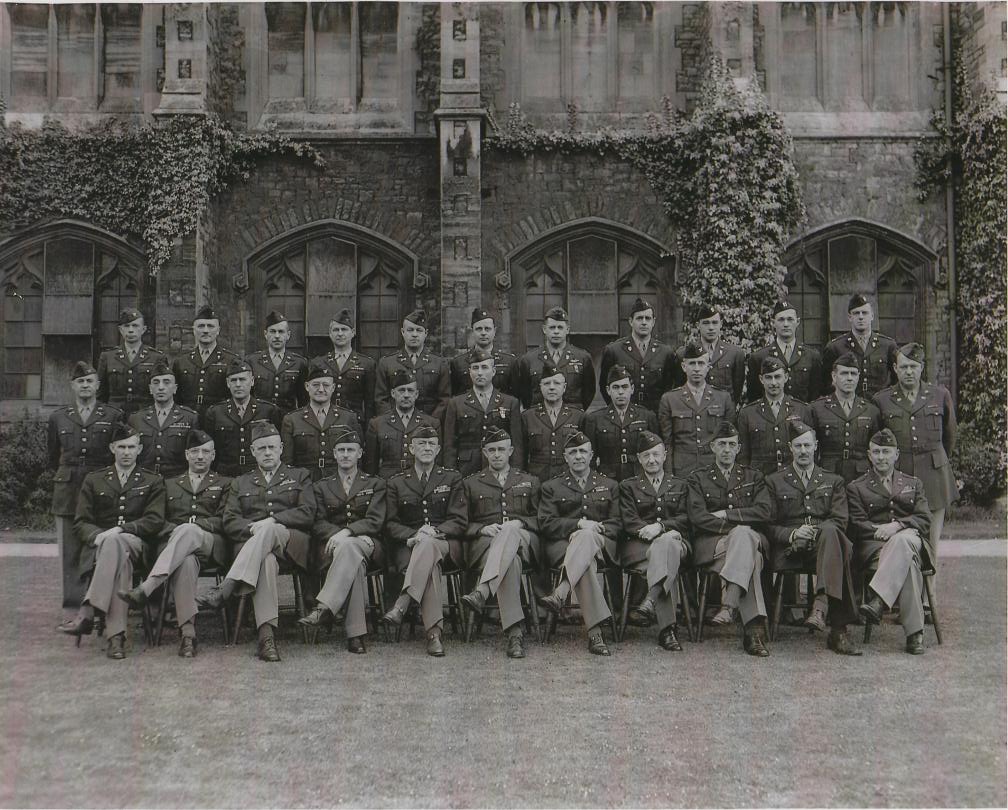
With First Army planning taking place at Clifton College, many of the staff were billeted onsite. The staff sections were housed in the main building with officers taking over the school masters’ houses, which lined the central field. The enlisted men bunked in the field house at the end of the site or in the boys’ dorms. The choice of The Holmes for Bradley was intentionally away from the college. As he explains, the planning was to be a “long and tedious ordeal” and if he were to spend long evenings at his desk, his staff would feel compelled to stay up with him. He wanted to keep them fresh for the battle ahead. The house was the site for many of the planning meetings with the senior US generals including Hodges, Armistead, Patton, Rickard and Devers.
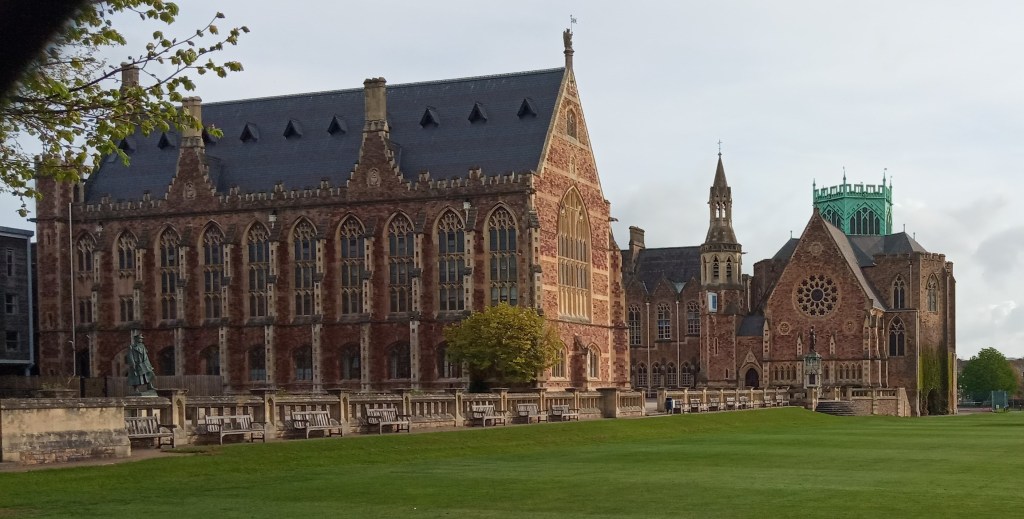
The book ‘A Command Post at War’ describes that at Clifton College chapel “the First Army’s commander welcomed the new arrivals, spoke briefly of the task ahead, directed them to show all due courtesy to their British hosts, and warned that those who presented disciplinary problems would soon find themselves in a front line unit.”
Ready for D-Day
Bradley went down to breakfast at 7:15 on Saturday 3rd June 1944 as he prepared to leave Bristol for the final time. Most of First Army headquarters had left several days before to board the army command ship at Portland. Shortly after 8, they left The Holmes and crossed the Clifton Suspension Bridge on their way to Plymouth passing through Taunton on the way. At Plymouth he “buckled on a pistol for the first time since Sicily”, put on a steel helmet and prepared himself for D-Day.
Bradley and his staff commanded the invasion on Utah and Omaha beaches from the ship Augusta and landed on 10th June. He commanded 1st US Army Group in the Battle of Normandy, through France and Belgium.
Christmas wishes were sent to him and his staff by the mayor on behalf of Bristol. He replied (during the Battle of the Bulge) “Your kind Christmas greetings help to recall our delightful months in Bristol where we readied our plans for these operations in which we are now engaged. It is always encouraging to hear again from friends whom we regarded as neighbours there. Will you accept for yourself and for the good people of your city my thanks for their friendship to our American troops during this last year, and express to them my hope that our joint efforts during the coming months may speed the way to happier holidays at home both for your young men and ours.”
Aftermath
In December 1945, General Omar Bradley was officially appointed as a “Friend of Bristol” with Christmas greetings. In his appreciative response to the mayor, Bradley said “Those of us who lived with you before the invasion are confident the faith and courage that sustained your city during the battle for Bristol will enable your people to rebuild it. It is a great pleasure to accept enrolment in the Roll Book of ‘Friends of Bristol’. May I express my cordial wishes to you and your people for happiness, success and renewed eminence in this new year.”
Sources:
A Soldier’s Story by Omar Bradley
Bristol University Botanic Gardens website
We’d love to hear your own stories. Please get in touch with us by emailing YanksinBristol@gmail.com
Copyright © 2026 – YanksInBristol.co.uk – No AI – All rights reserved.
 US Military in WW2 Bristol