
In spring 1944, a small group of young Americans, barely out of their teens, gathered by a wall in Henbury Road, Westbury-on-Trym. They were American G.I.s, from the US Army, some having volunteered and other drafted straight from high school. They were in Bristol as part of the Allied war effort determined to defeat Nazi Germany. The men were understandably anxious as they were about to begin their greatest adventure, the invasion of Normandy.
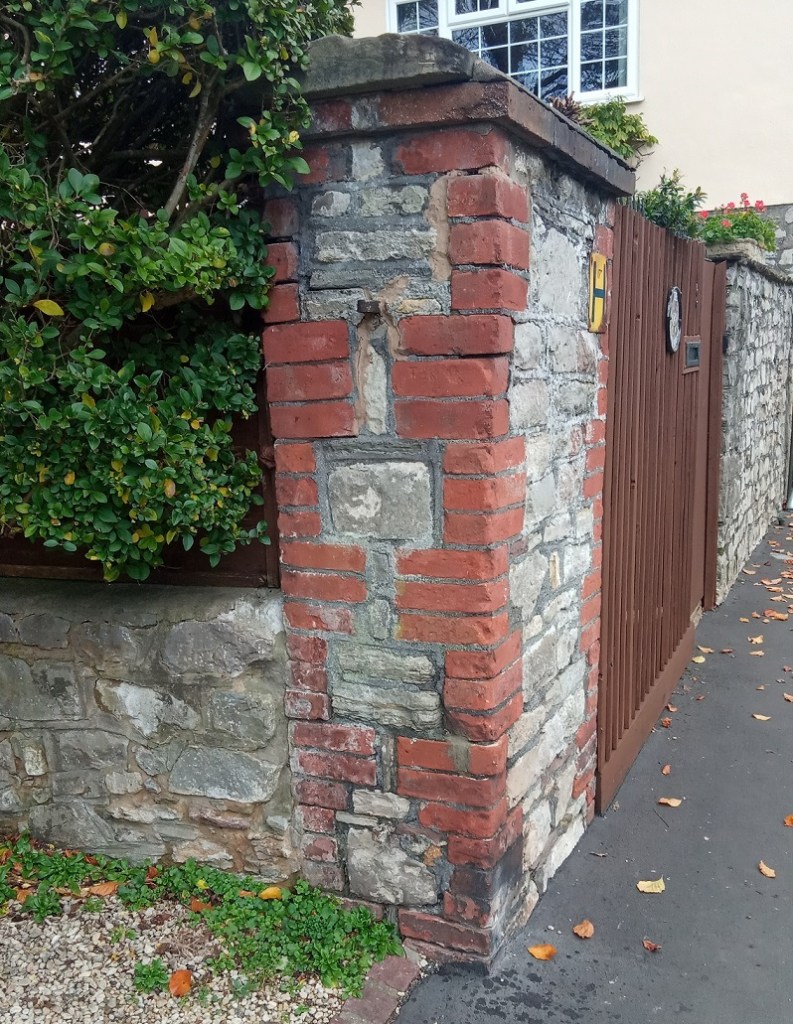
Having been mostly recruited from the South Central sates, the men had undergone basic training at Camp White in Oregon where they started to bond as brothers of a military unit. With basic training complete, they travelled by train to New York, from where they sailed across the Atlantic to Scotland and onward to war-torn Bristol. Unlike their comrades in rows of cold, damp huts, they were lucky enough to be billeted with a local family in Westbury-on-Trym and experience some basic home comforts.
Having likely been welcomed in the neighbourhood, they wanted to leave their mark and decided upon a subtle way. Each started to carve the name of their hometown into brickwork. One soldier carved his hometown ‘Fairmont, West Virginia‘ with clear, legible lettering. Another ‘Hillsboro, Texas‘ a city of less than 10,000 to the south of Dallas. After two successful carvings, the others had a go ‘Kansas City, Missouri‘, ‘Nashville, Tennessee‘, and a couple more, although not as deeply. As the brick dust blew away, they returned to their billets, packed their kit and prepared for their part in Operation Overlord.
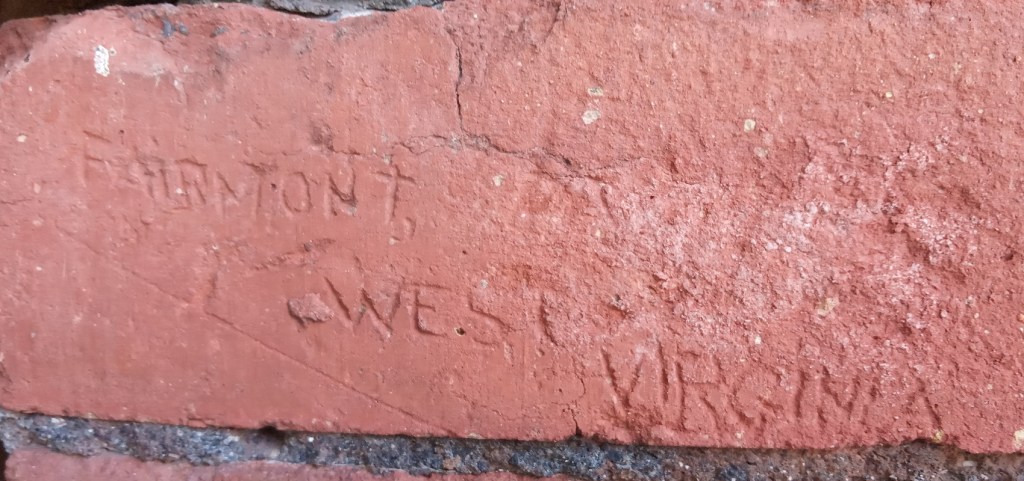
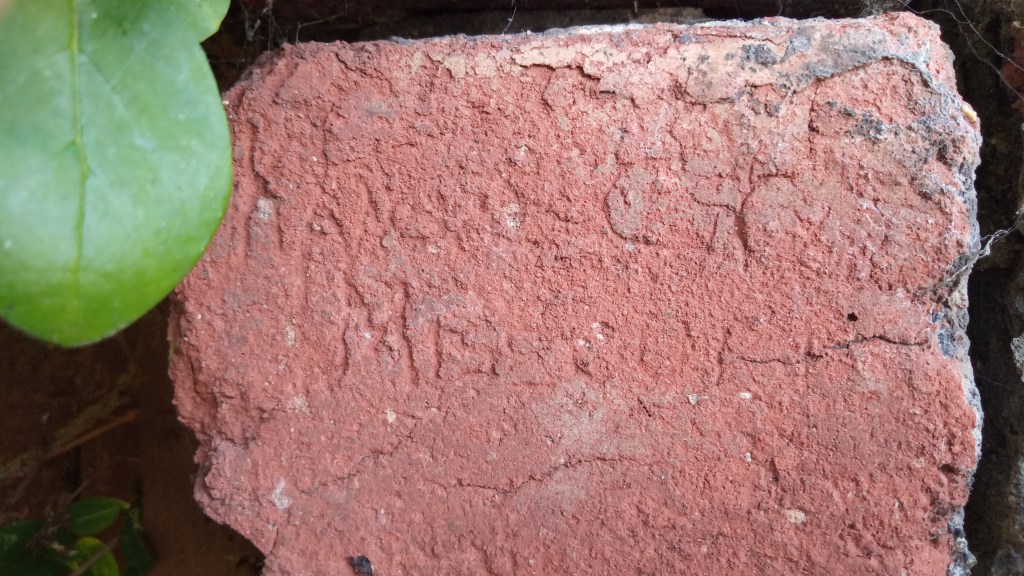
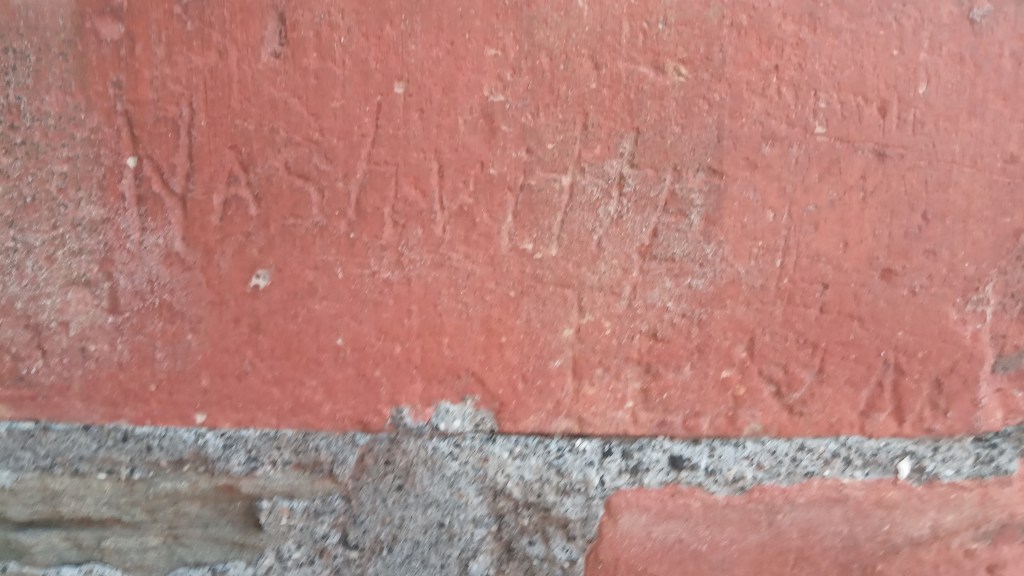
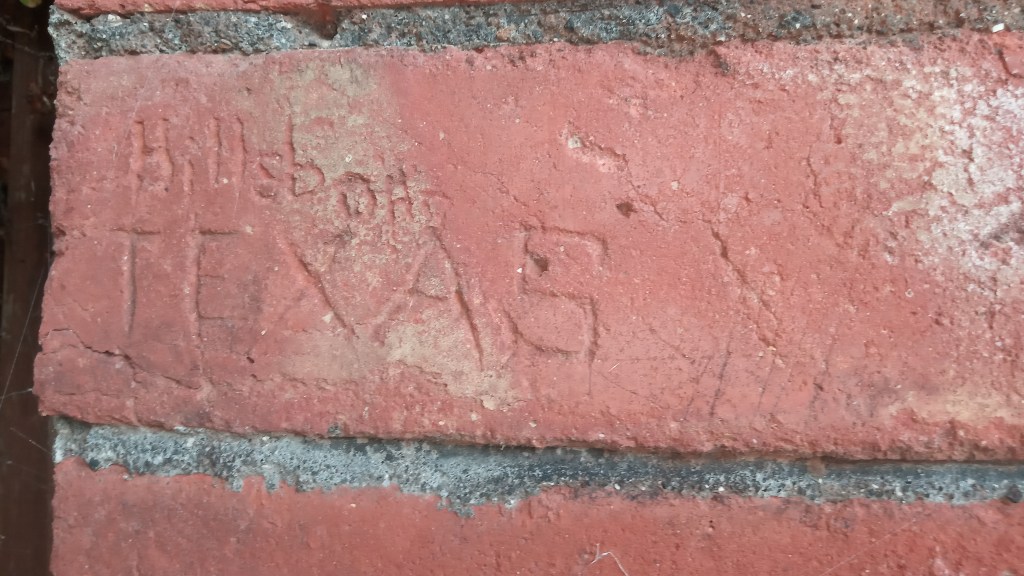
And there the names remained untouched and, perhaps, undiscovered long into peacetime. Perhaps some of the men returned with their families to show them the places where they once stayed, the pubs they drank in and the brick into which they carved a tiny slice of America. And perhaps some curious passers-by did notice the graffiti, understood its origin but had no way of knowing who had made them.
In September 2018, Kelly Sheppard was walking home from her work in a school in Henbury through Westbury-on-Trym. As she approached the High Street at the end of Henbury Road, she noticed something carved into a brick pillar at the end of a driveway. On closer inspection she found the American place names that had been etched 74 years previously. Luckily, Kelly had always loved history and enjoyed hearing her nan’s stories from the Second World War. She knew instantly that they must have been made by GIs and took photos, which she sent to her parents. However, with no one else as interested as her, the photos remained on her phone.
Three years later, I became curious about the American presence in Bristol in the Second World War and started researching the subject. Having found some interesting information, I started the website www.YanksinBristol.co.uk . To promote the stories on the site, I posted photos on the ‘Bristol Then and Now ‘ Facebook group. On one picture of a US Army victory parade along Wick Road in Brislington, Kelly casually mentioned the inscriptions she’d found. I was immediately curious and wanted to see them for myself!
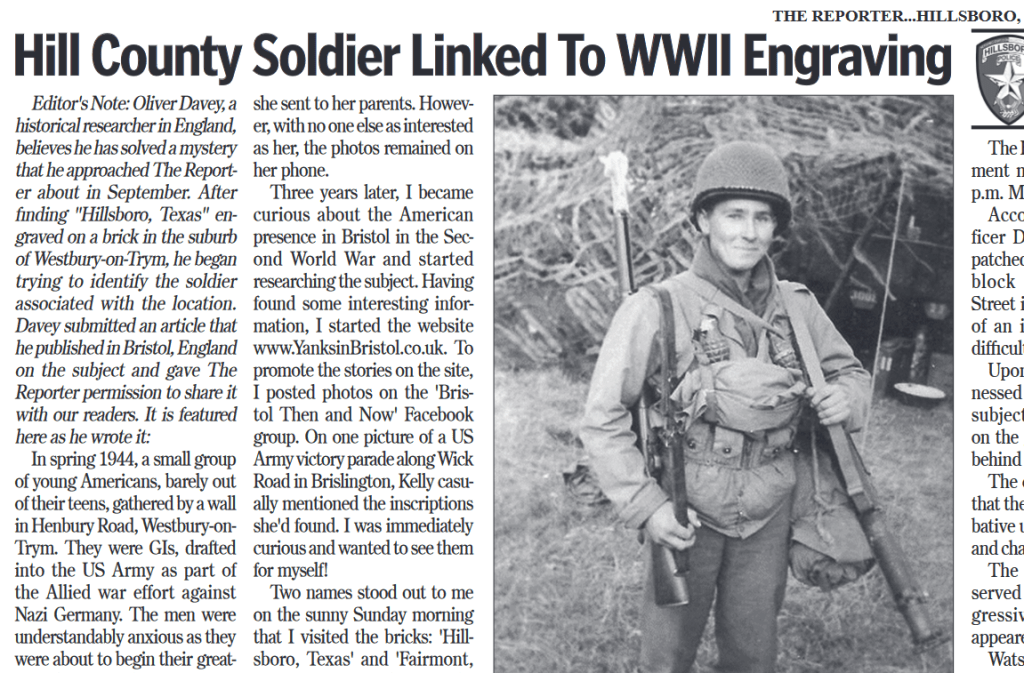
Two names stood out to me on the sunny Sunday morning that I visited the bricks: ‘Hillsboro, Texas’ and ‘Fairmont, West Virginia’. Both were relatively small cities so the culprits might be traceable. I contacted the Hillsboro Reporter newspaper who ran a story about my quest but no readers could recall an having ancestor that stayed in Bristol. The Fairmont community Facebook page that I joined, loved the story but again couldn’t provide a lead.
At the same time, Eugene Byrne published a story about my research in the Bristol Times and included a couple of photographs of the bricks. Sitting in her Weston-super-Mare house, 94 year old Jackie Atwell was enjoying the article. It brought back long-forgotten memories of her time during the Second World War when, as a teenage girl, her neighbourhood had an influx of American soldiers. At the end of the article, one photograph particularly caught her eye. It was the name Hillsboro, Texas carved into a brick in Westbury-on-Trym. This was an amazing coincidence – she’d lived in Westbury-on-Trym during the war and had dated a young GI from Hillsboro, Texas. She had to get in touch.

After I received an email from Jackie’s son, I phoned her and had the pleasure of listening to her wartime stories such as sheltering in her school cellar during the infamous Filton Raid. Jackie lived on Canford Lane and remembers how she would see lots of US servicemen around Westbury-on-Trym. One day, she was out walking with her friend, Hazel, and came across a couple of G.I.s and got chatting. One of the men was called Mike Browning who she described as ‘a lovely, lovely chap, a real gentleman’. They soon became close friends and dated. He was billeted in a house on Falcondale Road near the bottom of Henbury Road. The pair had lots of fun together such as having trips to Bristol Zoo.

With fellow researcher, Darren Little, we were able to add more detail to Corporal Mike Wollard Browning’s life from census records, his draft card and obituaries. He was born in Mertens, Texas on 23rd October 1924 and grew up in nearby Hillsboro with his parents and three sisters.
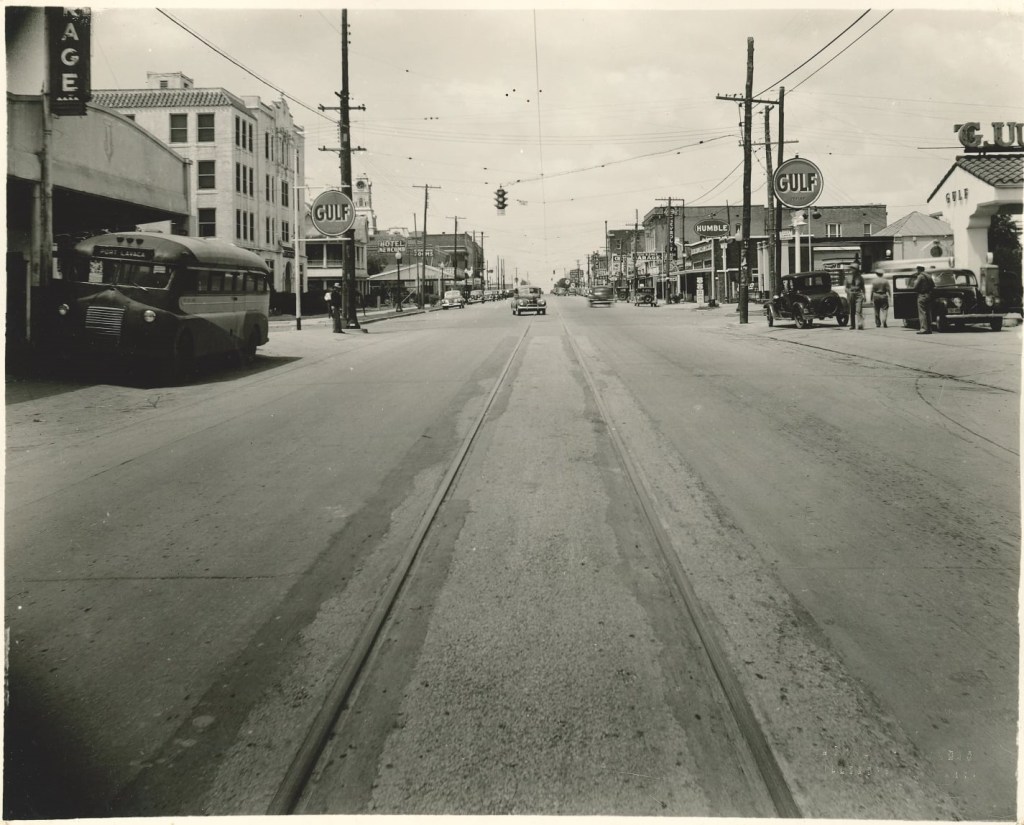
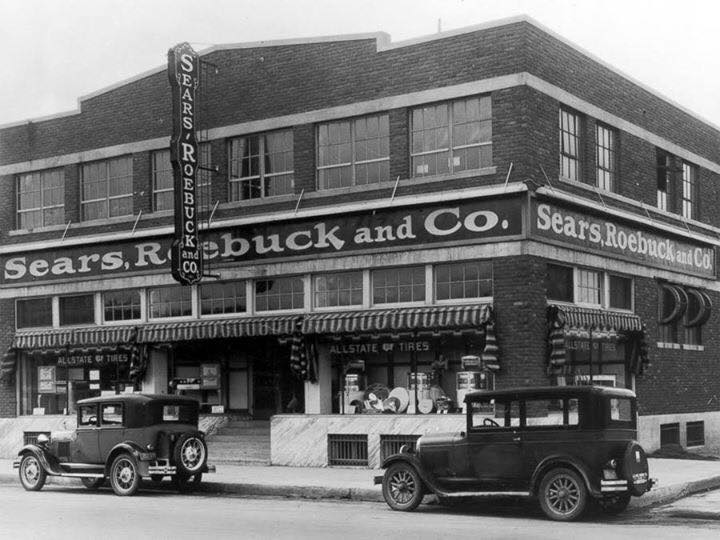
His father James was an automobile salesman. Aged 18, Mike enlisted into the US Army on 23rd February 1943 when he was working at Sears-Roebuck department store in Hillsboro while in high school. He was described as 5’7″ tall and weighing 140 pounds (10 stone) with grey eyes, brown hair and a sallow to light complexion. Having reached the rank of ‘Technician Fifth Grade’ (or Tec5), he would have had a particular technical skill without being trained as a combat leader.
The next big breakthrough came thanks to discovering Mike Browning in several family trees on Ancestry.com. After contacting the tree owners I had replies from different members of Mike’s family including his son, Larry, who could fill me in with much more information.
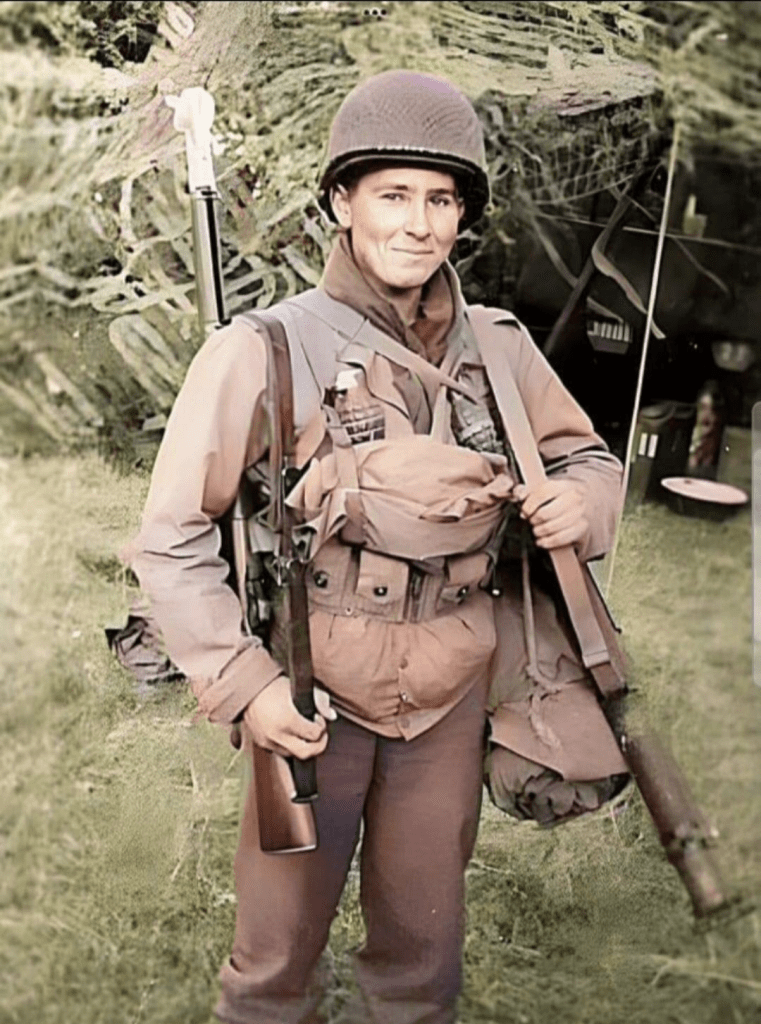
Mike Browning was a member of the 300th Engineer Combat Battalion (ECB), consisting of around 625 men. They’d arrived in December 1943, having sailed on the Queen Mary to Gourock, Scotland before travelling to a camp at Devizes, Wiltshire. While in England they completed their Military Operational Speciality (MOS) training as combat engineers.
Engineer Combat Battalions (or Combat Engineer Battalions) provided a wide variety of construction services supporting frontline troops including building pontoon bridges and clearing hazards. To quote the mantra of the 300th “If the Allies needed one and didn’t have one the Combat Engineers would build and defend one. If the Germans had one that we didn’t like, well the Engineers would simply blow it up!”
Despite the unit being listed at Devizes and the Chiseldon Camp, Wiltshire, many of the men moved to billets in the Westbury-on-Trym area. They were there to build a camp for the US Army, which included the Southside Wood camp and possibly that on Shirehampton Golf Course.
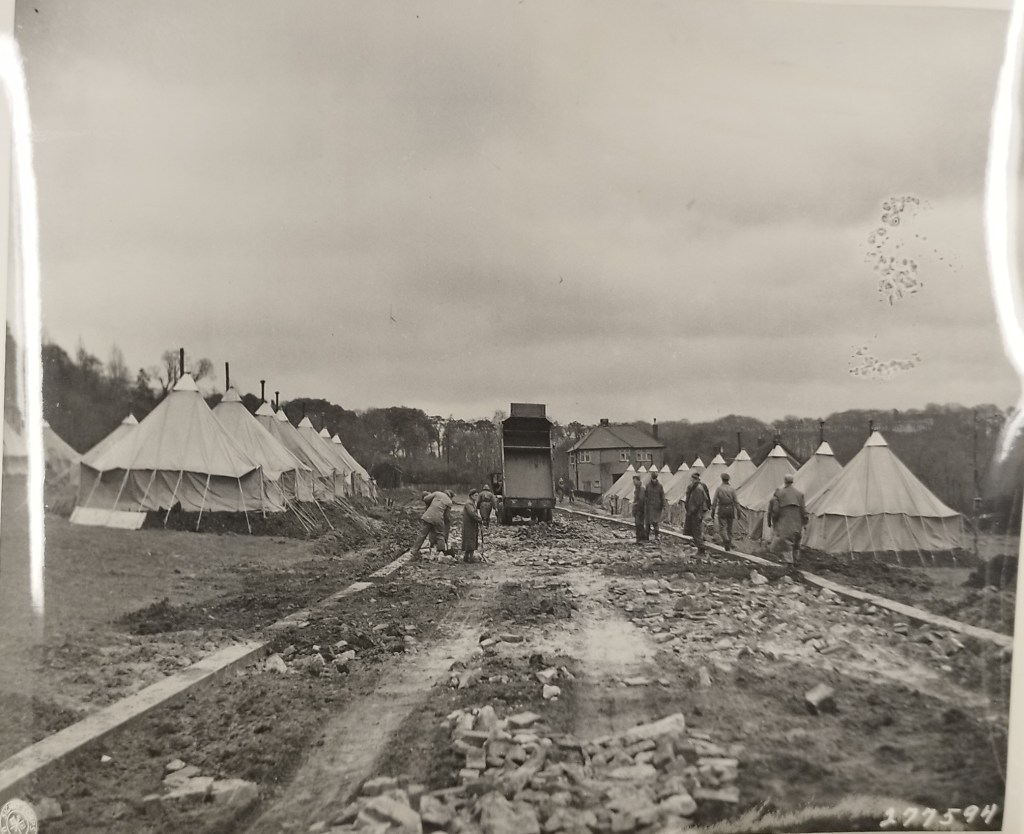
Jackie Atwell remembers how one day Mike Browning was gone without notice. Many of the American soldiers had done the same as they went into secure transit camps prior to embarkation for D-Day, 6th June 1944.
The first wave of the 300th Engineer Combat Battalion arrived at Utah Beach on 16th June 1944 (D+10) to clear mines in the path of 101st Airborne Division. Three days later, the second echelon were approaching Utah Beach when tragedy struck. The LST (Landing Ship-Tank) they were on struck a mine and 95 of the engineers were killed by the blast. The third wave joined them soon after. We don’t know which of the three Mike was on but the loss of so many comrades must have been terrible.
The 300th ECB helped pave the way for US First Army’s progress through Normandy, northern France and Belgium. Demolition experts would demolish obstacles, clear minefields and destroy bridges that might be used in a counterattack. Construction crews would build roads, throw spans across rivers, establish water stations, lay minefields and create their own deadly obstacles. They were at the sharp end of the Battle of the Bulge in winter 1944/45 before the advance into Germany.
Following VE Day and the end of the fighting in Europe, Mike returned to Bristol and visited Jackie while on leave in July 1945 (she has a photo of them in her back garden). As Jackie says, it was nearly 80 years ago and she hasn’t thought about it much but she does remember a happy time together at a fair on the Downs. Her and Mike had a terrific time on the bumper cars.
For his part, Mike Browning didn’t speak of the war much to his family but he did tell his son about meeting a beautiful young woman in Bristol who was ‘very special‘ to him.
Mike returned to his unit for a few months before shipping back to the US for demobilisation on 8th December 1945. Jackie thinks that she and Mike had brief correspondence after the war but it quickly fizzled out.
In civilian life, Mike became a cable splicer for Southwestern Bell Telephone Company, living in Gainesville, Fort Worth, and Beckville, Texas east of Dallas. He married and had two sons and a daughter. While living in Beckville, Mike took early retirement due to health issues. The extra time meant Mike could enjoy gardening, was an avid ham radio operator, carpenter and general jack of all trades. He enjoyed time spent with his children, grandchildren and was a faithful member of the First United Methodist Church. Sadly though, he did not have the long life that many US veterans had. He died on 27th May 1979 of heart failure aged just 54. He is buried in Beckville with his wife, Lurine.

From around the mid 1960s, the veterans of the 300th Engineer Combat Battalion held annual reunions. Mike was very proud to have served his country and considered those men that went through hell together brothers and each one family, that he loved. The reunions carried on until 2015 with just five surviving veterans attending. In their home country, they were known as ‘The Greatest Generation’.
So how sure can we be that Mike Browning was responsible for carving his hometown into the wall in Henbury Road? Do we know that the places were carved as described at the start of the article? To the latter question, the answer is no but it is a reasonable scenario and is consistent with other veterans’ experience of Bristol.
Ancestry.com lists over a thousand Hillsboro men who registered for the draft in the Second World War. Many of these were overage and wouldn’t have served overseas if at all. Others would have been posted to the Pacific or with US Fifth Army in Italy. Of those who ended up in Britain or Northern Ireland, a few may have come to Bristol but, as far as our research shows, there was no big camp in Westbury-on-Trym only billets in private houses. The chance of a second Hillsboro man living nearby is remote at best. Mike lived within 5 minutes’ walk from the bricks and so it’s almost certain that he was the one to leave his own little trace of Texas in a corner of Bristol.
This story was published in the Hillsboro Reporter on 16th November 2023 and Bristol Post and Western Daily Press on 5th December 2023. It featured in a BBC Points West article on 28th June 2024. It is due to appear in an exhibition about soldiers’ graffiti through time in the National Museum of the US Army in Virginia in October 2025.

This investigation was only possible with a lot of luck and serendipity but also with many thanks to Kelly Sheppard, Jackie and Paul Atwell, Darren Little, Euan Withersby, Eugene Byrne (Bristol Times) and Sharon Cottongame (Hillsboro Reporter). Also thanks to Will from CART for suggesting the best approach to research. Making contact with the Browning family has added much more information so a special thanks is particularly due to Larry.
A similar investigation into names carved into bricks in Norfolk by Dave Cole is here and is equally fascinating. Additionally, names carved into trees by men of the 101st Airborne Division is included as part of this excellent Time Team: Digging Band of Brothers episode on YouTube. A story of a GI’s helmet, found in Cornwall, being reunited with its original owner’s family is here. The BBC has this story about graffiti in a castle in Northern Ireland. The IWM has a story of names on a wall in Southampton.
We’d love to hear your own stories. Please get in touch with us by emailing YanksinBristol@gmail.com
Copyright © 2026 – YanksInBristol.co.uk – No AI – All rights reserved.
 US Military in WW2 Bristol