
The following is an extract from ‘Medicine Under Canvas‘, a book published in 1949 about a unit that was, for a time, stationed at Frenchay Hospital.
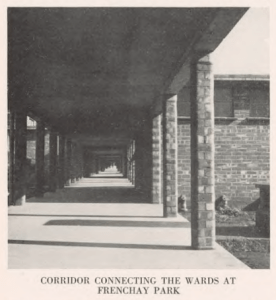
On September 4 [1942], a detail of seventy-five officers and men left Tidworth and traveled by train to Frenchay Park, on the edge of Bristol, to take over a new hospital plant still under construction there. This institution was being built by the people of Bristol as a crippled children’s hospital, but as the need for hospitals for American troops increased, had been taken over by an American station hospital. The buildings were one-story brick and tile construction with flat roofs, and were well dispersed among the trees of a flat, park-like area. Several of the buildings, including living quarters, wards, operating ward, and administration building, had been completed, and the advance detail now set to work cleaning up the buildings and installing the British equipment as it was brought in.
Within a few days the remainder of the officers and men, and all the nurses arrived. The officers and men considered such things as a good roof, a bed, and a warm building strictly as luxuries, and with the boost in morale attendant upon getting out of the cold, wet tents, the work of cleaning up went forward rapidly. American rations were now available and the food, prepared in the large, modern kitchen was, on the whole, excellent in comparison to the fare at Tidworth.
The headquarters and finance section began to function more smoothly, and on September 10 a paymaster was located and the unit was paid for the first time in about seven weeks. With money in their pockets, the extracurricular activities of the 77th people began to increase. Trips to London on 48-hour pass were fairly numerous, and attendance at the local dances, pubs, and theaters increased considerably, Many acquaintances and friendships were established with the citizens of Bristol and its outlying villages of Staple Hill and Fishponds, some of which are still maintained by correspondence. The Lord Mayor of the City of Bristol, resplendent in silk hat and the other regalia of his office, visited the hospital with his retinue and had lunch at the officers’ and nurses’ mess. As more and more of the members of the unit were invited into the homes of the people of the community, there was less misunderstanding between them.
In spite of the fact that these people were on strict food rationing, they generously shared their meager stores with the American soldiers and apologized because they had so little to offer. Soon, nearly every man had a favorite pub, a skittle league, or a girl in the neighborhood to occupy his off-duty hours. A party was given by the enlisted men in one of the larger vacant buildings on the hospital grounds, affording an opportunity to show the English girls the “American way’ of throwing a party. The affair was very well attended, and although the girls did not care for the American beer which they maintained was too cold, they were amazed by the huge amounts of sandwiches, candy, and peanuts so generously proffered them. Several nurses helped with the decorations and refreshments, and worked in the powder room.
The officers and nurses shared the same mess hall and recreation rooms and in off-duty hours a constrained group of nurses would congregate in one end of the recreation hall while an equally constrained and austere group of doctors kept to their end of the room. An attempt to organize an officers’ club failed chiefly because at that early stage no need for organized recreation was felt. The first ration of British NAAFI spirits was distributed equally, but left an excess of nearly two cases of gin. A dance had been planned, and in the punch, extremely well concealed in the various fruit juices, were the two cases of gin. After an hour or so of freely imbibing this delicious and healthful punch, the most haughty became jovial, rank lost its privileges, and informality prevailed. Many experienced difficulty in navigating the fifty yards or so of concrete walk to their quarters in the blackout, and several unkind things were said about construction companies who would leave open ditches on the grounds. After this ice-breaking episode, congeniality became more evident in the mess and recreation halls. Occasional social functions by both civilian and military groups of the British in the Bristol area were attended by groups of officers and nurses who were always impressed by the stiff formality of these affairs.
Under the management of Capt. Howard Dukes, the first American PX ration was made available. An excellent variety of chocolate bars, peanuts, American canned beer and cigarettes could be purchased in plentiful amounts. At this time officers and nurses were issued clothing ration coupons, and shops in the city were besieged with requests for woolen sweaters, Scottish plaids, English tweeds, and other well known British products.
On the large commons bordering the hospital grounds, a baseball diamond and a football field were laid out, and the local citizenry always turned out in force to see these American games played. On occasions, the Americans were given an opportunity to see a game of cricket.
We’d love to hear your own stories. Please get in touch with us by emailing YanksinBristol@gmail.com
Copyright © 2026 – YanksInBristol.co.uk – No AI – All rights reserved.
 US Military in WW2 Bristol